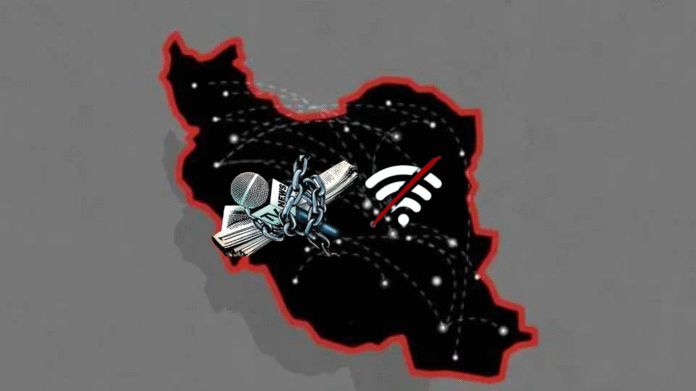
Three days after the ceasefire between Iran and the US-Israeli coalition, the internet in Iran remains almost entirely cut off, while the suppression of free journalism and independent reporting continues unabated. Media outlets are facing severe financial crises, widespread layoffs of journalists have occurred, and the confiscation of assets belonging to employees of Persian-language media outlets based abroad has now entered the enforcement stage.
The internet blackout in Iran, which began just hours after the start of the war, has now exceeded 1,000 hours — setting a new world record for the longest deliberate nationwide internet shutdown. Communication networks across the country continue to suffer from severe disruptions. News flow is strictly one-sided, dominated by the Islamic Republic’s state propaganda apparatus, while independent and free reporting has been effectively halted.
The Tehran Association of Journalists issued a statement yesterday warning that the continued internet blackout and severe restrictions on free information have pushed Iranian media and journalists into a critical situation. The statement reads: “Field evidence and received reports indicate that in recent months, the intensification of financial problems for media organizations -coupled with a sharp rise in production costs, especially in paper and printing, declining advertising revenues, and severe disruptions in internet infrastructure- has created serious additional difficulties for many media outlets.”
According to the association, the war and the Iranian government’s restrictions on the media have triggered “a wave of layoffs in Esfand and Farvardin [March and April], resulting in the unemployment of numerous journalists and media workers.”
At the same time as the crackdown on free information inside Iran, threats and judicial actions against Iranian journalists working abroad have also intensified. On Saturday, April 11, 2026, the state-run Mehr News Agency -affiliated with the Islamic Propagation Organization- published the names of dozens of employees of the Persian-language television channels Iran International and Manoto, announcing that their assets in Iran have been confiscated.
Citing the Judiciary of the Islamic Republic and invoking the “Law on Intensifying Punishment for Espionage and Cooperation with Hostile States,” Mehr accused the staff of Iran International and Manoto of cooperating with the United States and Israel.
Since the beginning of the US-Israeli war against Iran, Iranian citizens have been experiencing the most severe disruption in the free flow of information in the history of the Islamic Republic. In terms of scale, duration, and intensity, the current situation is unprecedented and far exceeds previous internet shutdowns during nationwide protests. Traditional metrics for measuring press freedom and media suppression are no longer sufficient to document the conditions in Iran today.
The combination of a near-total internet blackout, widespread restrictions on independent narratives, and judicial-security crackdowns against media outlets and journalists -both inside the country and abroad- has effectively plunged Iran into a complete informational blackout.