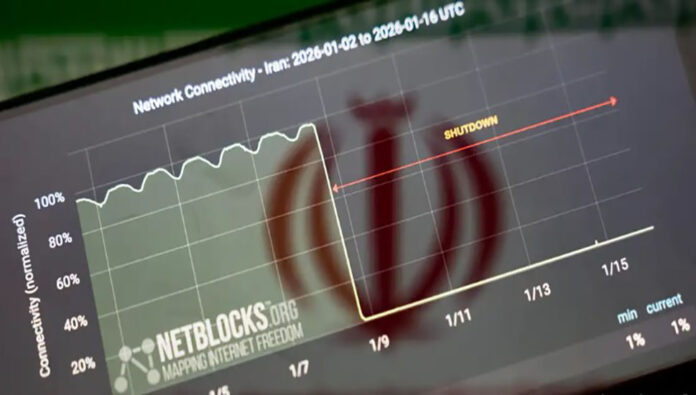
On the 38th day since the start of the war, the Iranian regime has broken longest nation-scale internet shutdown on record in any country. At the same time, judicial and security crackdowns on Iranian journalists inside and outside the country continue, alongside the closure of media outlets and widespread layoffs of journalists.
On Monday, April 6, 2026 (17 Farvardin 1405), Iran experienced its 38th consecutive day of complete international internet outage. According to NetBlocks, the non-governmental organization monitoring internet disruptions, Iran has now recorded more than 888 hours of continuous nationwide internet shutdown, setting a new global record for deliberate internet blackout. The Islamic Republic has maintained this total internet cutoff since the very first day of the war. Communication networks in the country remain under severe disruption, news flow is one-sided and controlled exclusively by the regime’s propaganda apparatus, and independent and free reporting has effectively been halted.
Meanwhile, Tehran’s Public and Revolutionary Prosecutor announced the issuance of orders to identify, seize assets, and block bank accounts of more than 100 Iranian citizens opposing the Islamic Republic who reside abroad. Ali Salehi described them -without naming individuals- as “actors, athletes, managers, journalists, and well-known figures supporting the enemy from outside the country.”
Simultaneously, the judiciary’s official news agency, Mizan, reported that the Tehran Prosecutor has ordered the blocking and seizure of assets, along with the identification of bank accounts, for 63 managers and employees of Iran International network and 25 managers and employees of Manoto network.
In recent days, state-controlled Iranian media have repeatedly reported the arrest of citizens who send news and images to foreign media outlets. These regime-affiliated outlets have also announced the detention of individuals in various cities across Iran for using or selling Starlink devices.
As the war enters its 38th day, alongside the unprecedented digital blackout and widespread suppression of free information, independent and non-governmental media outlets in Iran are shutting down one after another or carrying out mass layoffs of journalists. In recent days, the newspaper Payam-e Ma announced it would cease publication until further notice, and the magazine Shabakeh Aftab has ended its operations.
The newspaper Shargh also published a report stating that “more than one hundred staff members, including journalists and administrative personnel, have been laid off from Donya-ye Eghtesad, one of the country’s largest private media organizations.” In another part of the report, Shargh noted the non-payment of salaries in several Iranian media outlets, writing: “Some media organizations have refused to pay their staff’s March salaries. Reports indicate that this has occurred in several news agencies and newspapers, with neither March salaries nor Eid bonuses paid to employees.”
Iran has entered the 38th day of the war while the Islamic Republic, in parallel with the internet shutdown and intensified judicial and security measures against independent voices, is attempting to impose its official narrative on public opinion. It is doing so by organizing large-scale campaigns through state television, national newspapers, pseudo-media outlets, pro-regime social media activists, and users loyal to the system. These campaigns, often disseminated in multiple languages and sometimes using AI-generated images and videos, aim to push the Islamic Republic’s narrative globally.