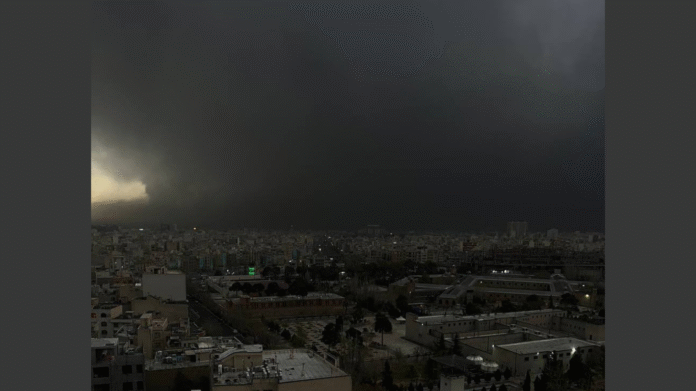
On the tenth day since the outbreak of war in Iran, internet access remains completely cut off across the country. At least one journalist has been killed in U.S. and Israeli airstrikes, while judicial and security institutions of the Islamic Republic have sharply intensified their threats against independent journalism.
Masoud Salimi, a journalist and former head of the Tasnim News Agency bureau in Qom, was killed on March 8, 2026 in Israeli and American airstrikes. The news was reported by Tasnim News Agency, affiliated with the Islamic Revolutionary Guard Corps (IRGC).
At the same time, multiple judicial and security bodies have issued separate statements criminalizing any independent reporting related to the war. In the most recent instance, the Media Center of Iran’s Judiciary released a threatening notice stating: “Publishing photos or videos that help complete the enemy’s puzzle in creating fear inside Iran or gathering intelligence for the enemy constitutes an offense and a crime, and decisive legal action will be taken against those who publish such material.”
Earlier, Gholam-Hossein Mohseni Eje’i, Head of the Judiciary explicitly threatened Iranian citizens in a video interview. He described any action or statement by citizens that he deems “in line with the enemy’s wishes” as an act of “enmity,” warning that such individuals would face treatment “based on wartime principles.”
In a separate statement, the Prosecutor-General’s Office of Iran declared: “The assets of any Iranians residing abroad who echo, support, or cooperate with the enemy will be confiscated in accordance with the law.” Given the judiciary and security apparatus’s history of extraterritorial actions against Persian-language journalists and media workers outside Iran, this threat from the Prosecutor-General’s Office should be regarded as a new and deeply alarming development targeting opposition journalists.
The Ministry of Intelligence of the Islamic Republic also issued a statement prohibiting any photography or filming of “sensitive locations or damaged sites.” This directive effectively imposes severe restrictions on on-the-ground reporting by journalists and reporters inside Iran.
Meanwhile, security and judicial institutions have been widely sending SMS messages to Iranian citizens, labeling the filming of war-related damage, sharing such material on social media, or transmitting it to foreign media outlets as a “crime.”
Over the past few days, heavy bombardment of Tehran has damaged the headquarters of the state-run Mehr News Agency (affiliated with the Islamic Development Organization), the Islamic Republic of Iran Broadcasting (IRIB / national television), and parts of the Sazandegi newspaper building. According to available reports, no media staff were injured in these attacks.
Iran has now entered the tenth day of military strikes by Israel and the United States. Since the very first day of the war, the Islamic Republic has imposed a nationwide internet blackout. Communication networks continue to suffer severe disruptions, and free and independent journalism has been effectively silenced.
The selection of Mojtaba Khamenei, son of the former Supreme Leader, as the new Leader of Iran has further intensified pressure and restrictions on the media. News flow inside the country is now entirely one-sided and controlled by the Islamic Republic’s official propaganda apparatus.
In the midst of war, Iranian citizens need reliable, timely, and essential information more than ever. Yet the current situation has left many events shrouded in ambiguity and confusion, severely hampering society’s ability to understand reality and make informed decisions.