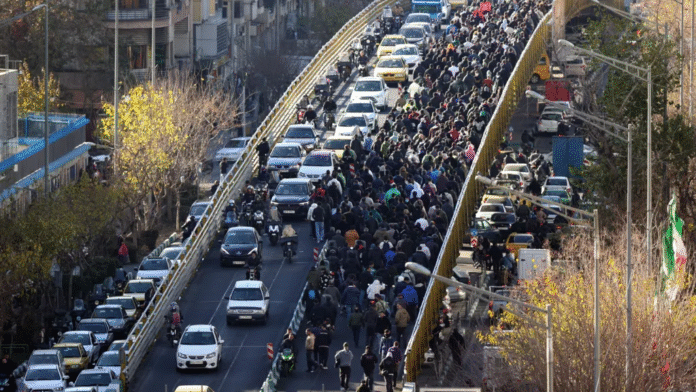
As anti-government protests continue in Iran, organized disruptions to independent reporting in the country persist. The Islamic Republic, through summoning journalists to security agencies, holding “briefing” sessions with media outlet managers, severe internet disruptions, and producing parallel narratives, prevents citizens from accessing reliable and timely information.
According to reports received by the Defending Free Flow of Information Organization (DeFFI), in recent days, the Intelligence Organization of the Islamic Revolutionary Guard Corps (IRGC) summoned several journalists to its facilities and threatened them against reporting on the anti-government protests. This security agency also contacted at least four journalists by phone, citing what it described as the “sensitive conditions of the country,” and demanded that they refrain from preparing reports or reposting news about the protests.
In at least one case, IRGC intelligence agents told a journalist that any tweet posted on their personal account about the protests would immediately face “judicial action.” In another instance, after a journalist published a note on their personal Instagram page, they received a warning that, due to “the possibility of enemies exploiting the protests and the likelihood of terrorist operations,” there would be “no leniency toward collaborators with Israel”—a warning that appears to be an explicit threat of fabricating charges of collaboration with Israel.
On 28 December 2025, Tehran’s bazaar witnessed a strike by shopkeepers and their street protests against rising dollar prices and Iran’s economic crisis. These protests gradually spread to other areas of Tehran and cities across Iran, continuing into their eleventh consecutive day.
Over the past 11 days, Tehran’s bazaar and numerous neighborhoods in the city, several Iranian universities, and various cities throughout the country have seen anti-government protests. These demonstrations quickly evolved beyond initial economic grievances, taking on a political character, with slogans against Ali Khamenei, the Supreme Leader of the Islamic Republic, and the governing system becoming a prominent feature. The response from the Islamic Republic’s police and security forces involved unrestrained violence. Initial reports indicate dozens of protesting citizens were injured or killed.
Just one day after the strike began in Tehran’s bazaar, Gholam-Hossein Mohseni Eje’i, the head of the judiciary, in a speech threatened citizens he labeled “disruptors of the economic system” with “execution.” On the same day, Mehdi Beyk, the political editor of Etemad newspaper, was detained while reporting on the bazaar merchants’ strike and protests in Tehran, spending one day in custody.
Ali Khamenei, the Supreme Leader of the Islamic Republic, in his first response to the anti-government protests, described the protesting citizens as “a group of incited enemy mercenaries” and “rioters,” using threatening language to say: “Rioters must be put in their place.”
Additionally, immediately after the protests began in Iran—following a pattern repeated in previous provocative events—political and security officials contacted several media managers by phone and held at least two in-person meetings, urging them to avoid preparing or publishing challenging reports about the protests.
Another sophisticated pattern recurring in Iran involves disrupting citizens’ access to the internet. The Islamic Republic of Iran, in a model that has evolved over time, instead of a nationwide internet shutdown—similar to what occurred during the widespread protests of Aban 1398 (November 2019)—this time employed bandwidth reduction, regional disruptions, and instability in internet access to prevent citizens from having stable connectivity.