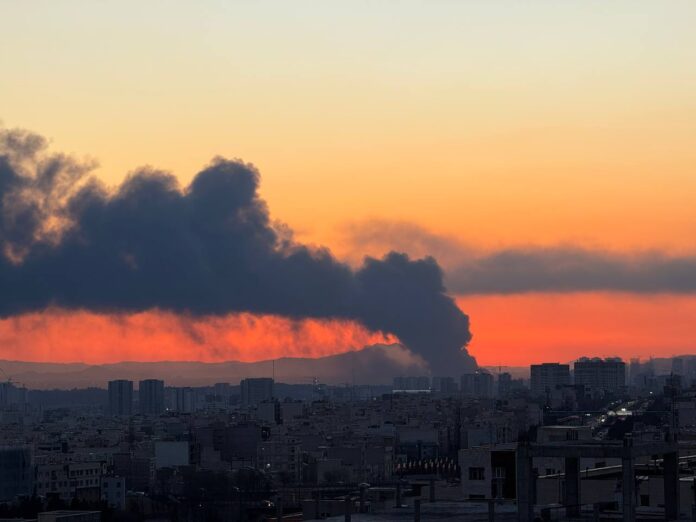
On the sixth day since the start of the U.S. and Israeli military attack on Iran, internet access in the country remains completely cut off. Widespread disruption to the free flow of information persists across Iran. The headquarters of the state broadcaster (IRIB) and the official Mehr News Agency have been damaged by airstrikes, and there is no information available on the fate of several imprisoned journalists.
Amid ongoing warfare in Iran, intense bombardment of Tehran has damaged the building of Mehr News Agency, affiliated with the Islamic Propaganda Organization. According to published reports, no staff members of Mehr News Agency were harmed in the incident.
In recent days, the Islamic Republic of Iran Broadcasting (IRIB) has also been targeted by airstrikes from the U.S.-Israeli coalition. Despite damage to parts of the national television building, no injuries or deaths among its staff have been reported.
At the same time, due to the internet shutdown and severe restrictions on information dissemination in Iran, there is no update on the current status of several imprisoned journalists. At least nine journalists and news photographers remain detained in Iranian prisons and detention centers: Somayeh Heydari, Pedram Alamdari, and Javad Aghajannejad in Tabriz; Hassan Abbasi in Bandar Abbas; Kianoush Darvishi, Mohammad Parsi, and Reza Valizadeh in Tehran; and Artin Ghazanfari in an unknown detention facility. “Shinnosuke Kawashima,” the Japanese citizen and head of NHK’s bureau, has also been detained by Islamic Republic security agencies since January 20, 2026.
Iran has now entered the sixth day of the military attacks by Israel and the United States. Since the very first day of the war, the Islamic Republic has imposed a nationwide internet blackout. Communication networks continue to suffer severe disruptions, news dissemination remains unidirectional through the regime’s propaganda apparatus, and independent and free reporting has effectively been halted.
In the midst of war, Iranian citizens need reliable, timely, and essential information more than ever. Yet many events are shrouded in ambiguity and confusion, leaving society struggling to analyze realities and make informed decisions.
Nevertheless, on Wednesday, March 4, 2026, Gholam-Hossein Mohseni-Eje’i, Head of the Judiciary and a member of the Interim Leadership Council, issued an explicit threat against Iranian citizens in an interview. He described any action or statement by citizens deemed “in line with the enemy’s wishes” as an act of enmity and warned that such individuals would face treatment “based on wartime principles.”
The Ministry of Intelligence of the Islamic Republic also issued a statement prohibiting any photography or filming of “sensitive locations or damaged sites.” This directive effectively imposes severe restrictions on on-the-ground reporting by journalists and reporters inside Iran.
The pattern of internet shutdowns combined with intensified judicial and security crackdowns on journalists, media outlets, and independent narrators is a recurring tactic employed by the Islamic Republic following major triggering events. During the 12-day war in June 2025—known as the “12-Day War”—the regime similarly imposed a nationwide internet blackout, launched a new wave of judicial and security actions against journalists and media, and severely disrupted independent reporting. In that Iran-Israel conflict, hundreds of civilians lost their lives in both Iran and Israel, including three Iranian journalists among the civilian casualties.
Intense U.S. and Israeli airstrikes on Iran continued into the sixth day. Multiple cities across the country witnessed missile impacts and repeated explosions. Hundreds of military, political, and security centers in Iran were targeted by Israeli and American attacks. At the same time, reports indicate that missiles and bombs struck a number of hospitals, schools, and civilian areas.
Over the past few days, dozens of high-ranking political and military officials—including Ali Khamenei, Supreme Leader of the Islamic Republic—have been killed in Israeli and U.S. strikes. Reports also confirm the deaths of dozens of civilians, including children, in military attacks on Iran. In response, the Islamic Republic of Iran has launched missiles and drones at numerous military, diplomatic, and civilian sites in Israel as well as in several neighboring countries. Some reports indicate civilian casualties and injuries in countries neighboring Iran.